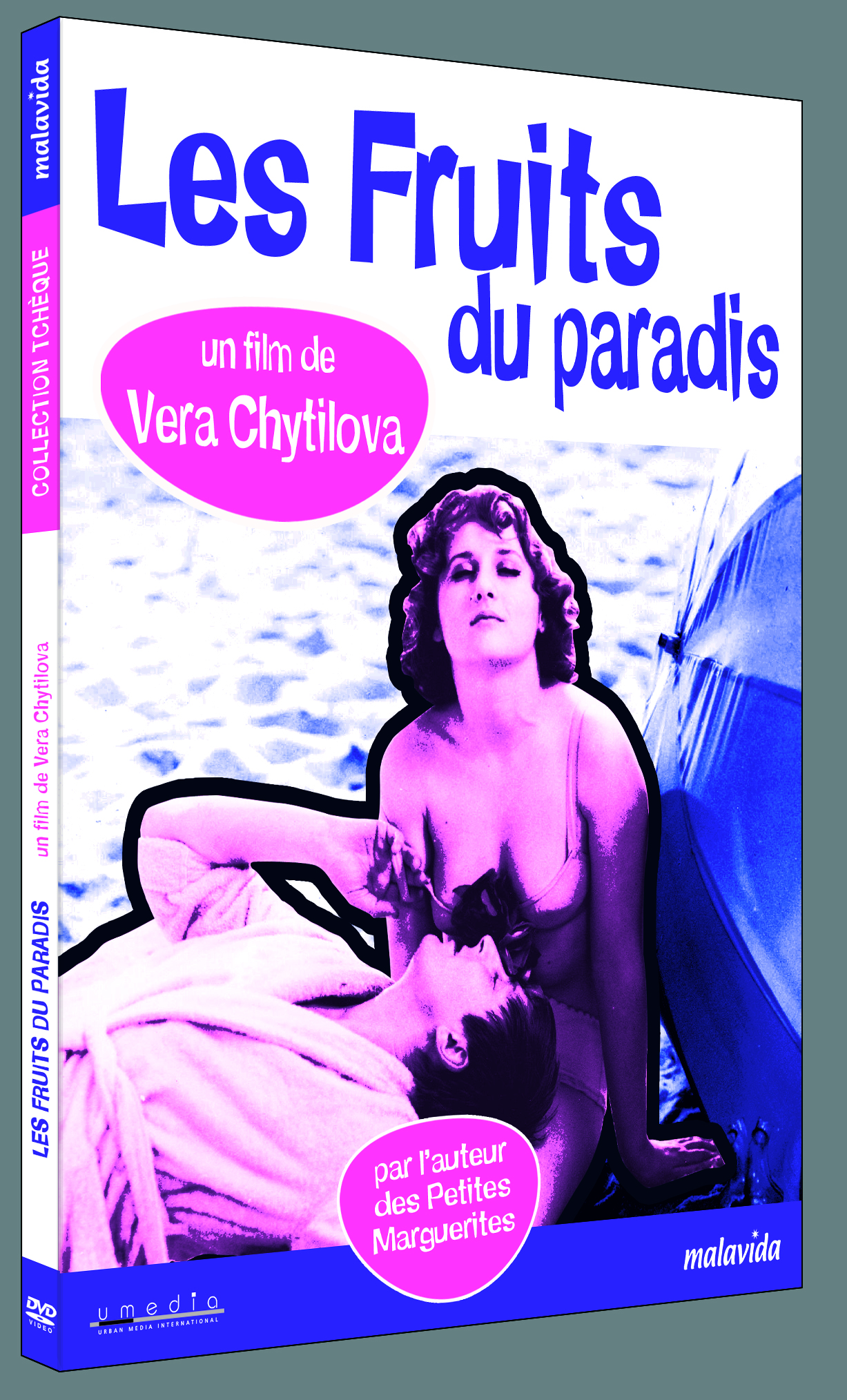
LES FRUITS DU PARADIS
Věra Chytilová
République tchèque - 1969 - 98 min
13,00 €
Titre original: OVOCE STROMU RAJSKYCH JIME
Titre anglais : WE EAT THE FRUITS OF THE TREES OF PARADISE
Version originale tchèque sous-titrée français
Vaut-il mieux vivre dans une heureuse ignorance ou faut-il choisir la vérité et subir les conséquences de la connaissance? Les époux Eva et Josef se trouvent dans une pension de famille. Eva, intriguée par Robert, un mystérieux étranger, visite sa chambre en cachette. Elle comprend qu’il s’agit de l’assassin de femmes recherché par la police. Josef ne veut pas y croire…
Le film suit immédiatement LES PETITES MARGUERITES dans la filmographie de Chytilova avec la même équipe : Jaroslav Kucera à la photo et Ester Krumbachova en co-scénariste et « art designer ». Le film, faisant preuve d’une trop grande liberté esthétique et scénaristique, est directement censuré en 1969. Audacieux dans son utilisation de la couleur et de la mise en espace, la construction scénaristique et les dialogues surréalistes ne pouvaient que choquer les tenants du réalisme socialiste. Un film avant-gardiste.
Bonus : chapitrage – master restauré · nouveaux sous-titres
Livret 32 pages : interviews de Vera Chytilova / Jaroslav Kucera / Ester Krumbachova
Fiche technique : DVD 9 · 1969 – 98 mn · couleur · Langue: Tchèque · Sous-titres: Français
En rupture de stock
Titre original: OVOCE STROMU RAJSKYCH JIME
Titre anglais : WE EAT THE FRUITS OF THE TREES OF PARADISE
Version originale tchèque sous-titrée français
Vaut-il mieux vivre dans une heureuse ignorance ou faut-il choisir la vérité et subir les conséquences de la connaissance? Les époux Eva et Josef se trouvent dans une pension de famille. Eva, intriguée par Robert, un mystérieux étranger, visite sa chambre en cachette. Elle comprend qu’il s’agit de l’assassin de femmes recherché par la police. Josef ne veut pas y croire…
Le film suit immédiatement LES PETITES MARGUERITES dans la filmographie de Chytilova avec la même équipe : Jaroslav Kucera à la photo et Ester Krumbachova en co-scénariste et « art designer ». Le film, faisant preuve d’une trop grande liberté esthétique et scénaristique, est directement censuré en 1969. Audacieux dans son utilisation de la couleur et de la mise en espace, la construction scénaristique et les dialogues surréalistes ne pouvaient que choquer les tenants du réalisme socialiste. Un film avant-gardiste.
Bonus : chapitrage – master restauré · nouveaux sous-titres
Livret 32 pages : interviews de Vera Chytilova / Jaroslav Kucera / Ester Krumbachova
Fiche technique : DVD 9 · 1969 – 98 mn · couleur · Langue: Tchèque · Sous-titres: Français
Bande-annonce
English description
English title: WE EAT THE FRUITS OF THE TREES OF PARADISE
Original title : OVOCE STROMU RAJSKYCH JIME
Directed by : Vera Chytilova
With : Jan Schmid, Jitka Novakova, Julius Albert, Karel Novak,
Czechoslovakia, 1969, 98 min
DVD 9, zone 2, color
Original Czech version with French subtitles
Bonus : chaptering · restored master · new subtitles
Booklet 32 pages : interviews of Vera Chytilova / Jaroslav Kucera / Ester Krumbachova
Vera Chytilova's WE EAT THE FRUITS OF THE TREES OF PARADISE, is a lost masterpiece of a film. "Lost" in the way that Chytilova was not permitted to make any films for decades, after her first film DAISIES, was censored and banned by the Soviet/Czech government. These films present a new language in cinema, that never got to develop. Her use of sound in this film puts her on par with Godard and Leone and her sense of story is like Bunuel or Svankmajer, albeit with a distinctly feminist, whimsicle, slapstick bent.
The story is an allegory of Adam and Eve, in a modern (made in 60's) Health Retreat. The action involves our heroin wandering the grounds where she becomes obsessed with a mysterious man, who may or may not be a killer.
Vera Chytilova was born on February 2, 1929, in Ostrava, Czechoslovakia (now Czech Republic). She studied philosophy and architecture in Brno for two years, then worked as a technical draftsman, a designer, a fashion model, a photo re-toucher, then worked as a clapper girl for Barrandov Film Studios in Prague. There she continued as a writer, actress, and assistant director.
She was denied a scholarship, or even a recommendation from Barrandov, but she took the admissions tests at FAMU and was accepted. From 1957-1962 she studied film directing under Otakar Vavra, who also taught Jiri Menzel, Milos Forman, Jan Nemec, and Ivan Passer. In 1962 she graduated as director. Her graduation film CEILING (1962) and the following film A BAGFUL OF FLEAS (1963) were "staged" improvisations with non-actors. In 1966 Chytilova and her husband, Jaroslav Kucera, made a witty surrealist comedy DAISIES (1966), which was immediately banned, but then was released in 1967, and won the Grand Prix at the Bergamo Film Festival. She remained in Czechoslovakia after the events of 1968, when her colleagues Milos Forman, Jan Nemec, and Ivan Passer emigrated abroad. Her films were often "shelved" for reasons of political censorship. For six years Chytilova was banned from making films. In 1976 she wrote a letter of complaint to President Gustav Husak, describing her artistic position. After some behind-the-scenes influence by her supporters, Chytilova was allowed to make a low-budget THE APPLE'S GAME (1977), which won a Silver Hugo at Chicago Film Festival.
Chytilova belongs among the foremost directors of the 1960's Czech New Wave, which was influenced by both the French New Wave and Italian Neo-Realism. Her films were acclaimed for visual experimentation and for bold unmasking of the moral problems of contemporary society. Her art belongs to what Sergei M. Eisenstein described as "intellectual cinema", that embraces the mix of "avant-garde", "cinema verite", "formalism", "feminism", or "happening" and, with a good deal of humor, it spreads beyond definitions. Chytilova's films often present a multi-layered plethora of visual associations that encourages the viewer to make active interpretations. She survived through the political turbulence in Czechoslovakia and has been a highly original and uncompromising filmmaker.