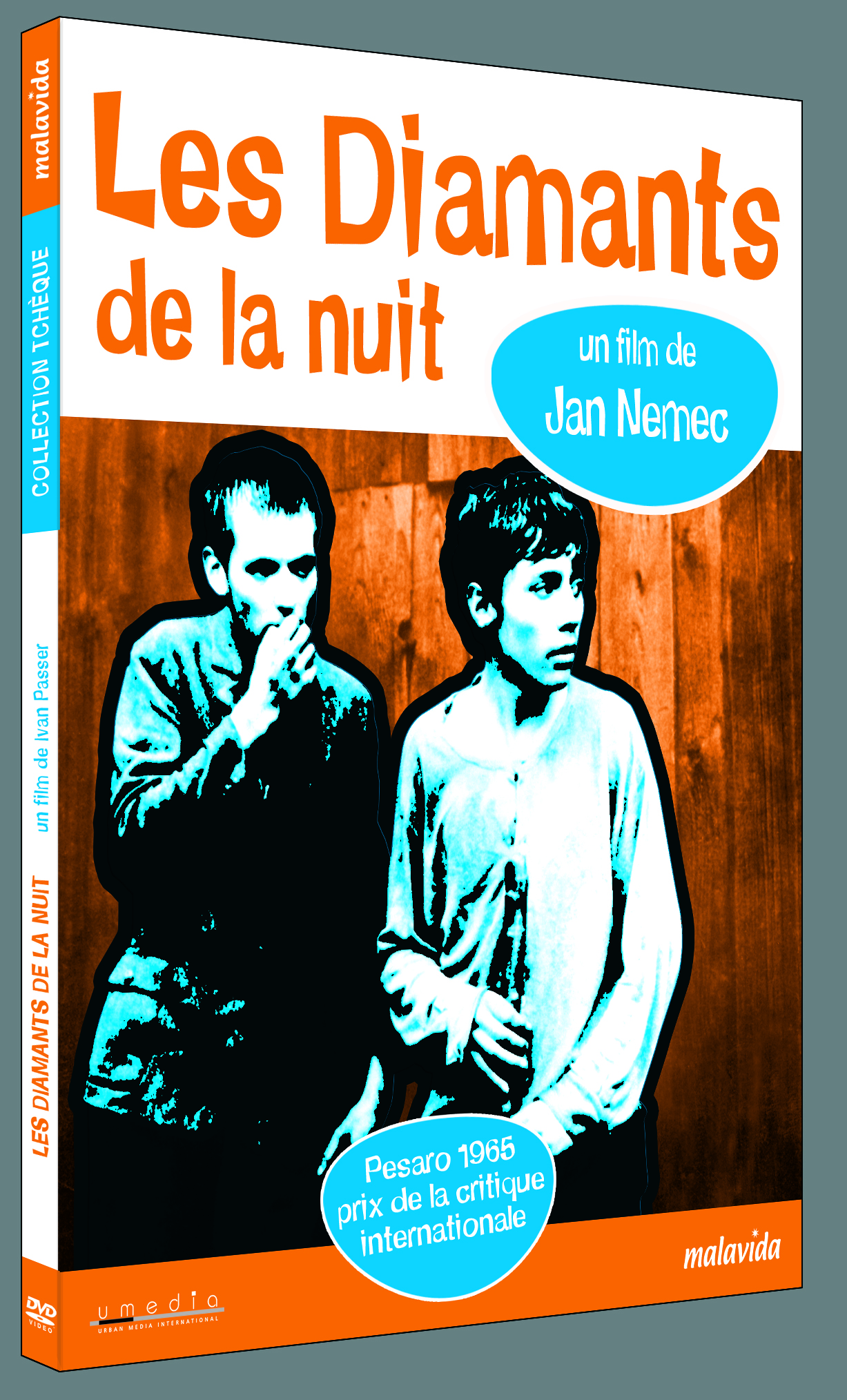
LES DIAMANTS DE LA NUIT

Jan Nemec

République tchèque - 1964 - 65 min

13,00 €

Deuxième guerre mondiale. Deux jeunes hommes sautent d’un train de déportés. Par miracle, ils gagnent la forêt où ils tentent de survivre. Au cours de leur course éperdue, ils revivent encore et encore des scènes de leur vie d’avant, au milieu d’hallucinations causées par la faim, la fatigue et la peur de mourir. Ils sont bientôt pourchassés par un groupe de vieillards armés.

UGS : cfecdb276f63 Catégories : ,

Grand Prix de la ville de Mannheim . Festival de Mannheim 1964

Prix de la critique internationale . Festival international du nouveau cinéma, Pesaro 1965

Version originale tchèque sous-titrée français

Deuxième guerre mondiale. Deux jeunes hommes sautent d’un train de déportés. Par miracle, ils gagnent la forêt où ils tentent de survivre. Au cours de leur course éperdue, ils revivent encore et encore des scènes de leur vie d’avant, au milieu d’hallucinations causées par la faim, la fatigue et la peur de mourir. Ils sont bientôt pourchassés par un groupe de vieillards armés.

Adaptation d’une nouvelle d’Arnost Lustig, le 1er long-métrage de Nemec, est une des œuvres qui pointent la naissance d’un nouveau cinéma tchèque, en liberté. S’y affirment un talent et une sensibilité originale au travers d’une recherche plastique et scénaristique. Le film a marqué les esprits, avec un parti pris de mise en scène courageux, à la limite de l’abstraction, influencé par le surréalisme et Resnais, et s’attaquant à la monstruosité du nazisme.

Bonus : chapitrage – master restauré · nouveaux sous-titres
Livret 20 pages : revue de presse d’époque · « Le miracle du cinéma tchécoslovaque » d’A. Liehm (article de 1963) – filmographie


Détails

RéalisateurJan Nemec
Année1964
PaysRépublique tchèque
Durée65 min
CastingLadislav Jansky, Antonin Kumbera, Irma Bischofova, Frantisek Vrana, Rudolf Stolle, Karel Navratil

Fiche technique

ZoneZone 2
ImageN&B

Bande-annonce

English description

English title: DIAMONDS OF THE NIGHT Original title: DEMANTY NOCY Directed by : Jan Nemec With : Ladislav Jansky, Antonin Kumbera, Irma Bischofova, Frantisek Vrana, Rudolf Stolle, Karel Navratil Czechoslovakia, 1964, 65 min DVD 9, zone 2, Noir & Blanc Original Czech version, with French subtitles Bonus : chaptering · restored master · new subtitles Booklet 20 pages : Press Review of the period of the film, "The Miracle of Czechoslovak cinema" by A. Liehm (article from 1963), filmography DIAMONDS OF THE NIGHT is the tense and brutal story of two Jewish boys who escape from a train transporting them from one concentration camp to another. Ultimately, they are hunted down by a group of old, armed home-guardians. The film goes beyond the themes of war and anti-Nazism and concerns itself with man's struggle to preserve human dignity. Nemec's career as a filmmaker in the late 1950s when he attended FAMU, the most prestigious institution for film training in Czechoslovakia. At this time, Czechoslovakia was a communist state subservient to the USSR and artistic and public expression was subject to censorship and government review. However, thanks largely to the failure of purely propagandist cinema in the early 1950s and the presence of important and powerful people within the Czechoslovak film industry, such as Jan Procházka, the 1960s led to an internationally acknowledged creative surge in Czechoslovak film that became known as the Czech New Wave, in which Němec played an instrumental part. The film historian Peter Hames has described him as the "enfant terrible of the Czech New Wave." DIAMONDS OF THE NIGHT was the first full-length movie from Czech filmmaker Jan Nemec and as many of the films that conformed the Prague Spring the movie is a perfect synthesis of different artistic movements (expressionism, surrealism, neorealism) and techniques, with a strong influence of documentary films. Nemec is not interested in the narration but he wants to implicate the spectators in the protagonists' experiences through the fabrication of an identity close to their mental state (with the support of subjective camera). Nemec has compared the movie with Tarkovski's IVAN'S CHILDHOOD due to in the film the reality is constantly sublimated through the dreams and visions provocated by the semi-feverish state of the two fugitives, in a kind of poetic realism. Nemec's motivations in placing the viewer in the skin of the two boys occupies a central role in the film since from a metaphysical point of view the film shows the struggle that everyone must choose along his life for freedom.