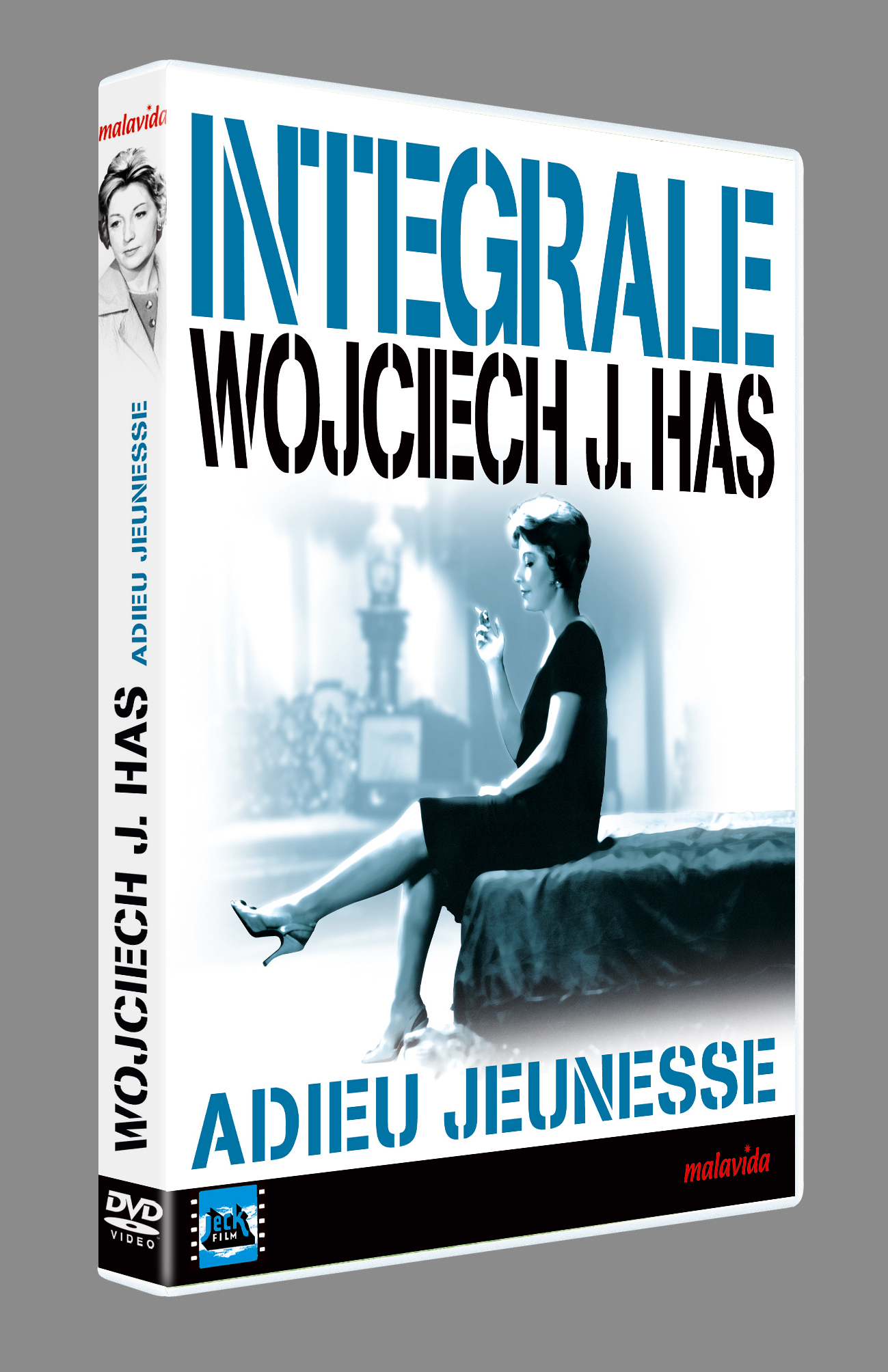
ADIEU JEUNESSE

Wojciech J. Has

Pologne - 1961 - 77 min

9,00 €

Magdalena, une comédienne vivant à Varsovie, retourne dans sa ville natale, en province, pour l’enterrement de son grand-père. Elle a la possibilité de conserver la demeure du défunt, où elle a passé sa jeunesse, à condition de s’y installer définitivement. Ses proches attendent fébrilement sa décision tandis que le jeune Olek, un étudiant rencontré dans le train, tombe sous son charme.

En rupture de stock

UGS : 7f1de29e6da1 Catégories : ,

Titre original : ROZSTANIE
Titre anglais : GOODBYE TO THE PAST

Magdalena, une comédienne vivant à Varsovie, retourne dans sa ville natale, en province, pour l’enterrement de son grand-père. Elle a la possibilité de conserver la demeure du défunt, où elle a passé sa jeunesse, à condition de s’y installer définitivement. Ses proches attendent fébrilement sa décision tandis que le jeune Olek, un étudiant rencontré dans le train, tombe sous son charme.

Wojciech J. Has est un des plus grands réalisateurs mondiaux. Il a su créer une œuvre profondément personnelle et originale, sans se cantonner à un genre précis. Virtuose dans son expression visuelle, techniquement d’une maîtrise absolue, il fit aussi preuve d’un profond humanisme. Cette intégrale permet la redécouverte dans une édition de qualité de toute son œuvre, une succession de véritables bijoux, permettant de comprendre un cheminement artistique aboutissant à une série de chefs d’œuvre comme LA POUPEE ou LA CLEPSYDRE.

Has nous offre ici une réflexion sur le temps, à travers les interactions complexes entre l’historique, avec les traditions périmées d’une Pologne figée, et l’intime, à travers les incertitudes de Magdalena, déchirée entre la prise de conscience de la fin de sa jeunesse et une histoire d’amour fulgurante. En bonus, une passionnante analyse du film, des points de vue artistique, historique et politique par Jacques Mandelbaum (LE MONDE)

Bonus : Chapitrage, filmographie, master restauré, analyse par J. Mandelbaum (11 mn)


Détails

RéalisateurWojciech J. Has
Année1961
PaysPologne
Durée77 min
CastingLidia Wysocka, Wladyslaw Kowalski, Gustaw Holoubek, Irena Netto, Adam Pawlikowski.

Fiche technique

Format4/3
ZoneZone 2
ImageN&B

Bande-annonce

English description

Original title : ROZSTANIE English title : GOODBYE TO THE PAST Directed by: Wojciech J. Has With: Lidia Wysocka, Wladyslaw Kowalski, Gustaw Holoubek, Irena Netto, Adam Pawlikowski. Poland, 1961, 4/3, 77min, zone 2, black and white Original Polish Version with French subtitles GOODBYE TO THE PAST is an adaptation of a novel written by Jadwiga Żylińska, published in "Dzikie ptaki". This is the intimate story of Magdalena (Lidia Wysocka) - a famous actress who returns to her hometown for her grandfather's funeral. Meeting her old acquaintances makes her think of the distance between herself and her former life - not exactly a physical distance, rather a temporal one. "If Wojciech Has had become a painter, he would surely have been a Surrealist," wrote the Polish critic Aleksander Jackiewicz. "He would have redrawn antique objects with all their real accoutrements and juxtaposed them in unexpected ways." Early on in his career, Has gained a reputation as an individualist who avoided political overtones in his art. He produced his most important films throughout the period when the Polish Film School was at its most prominent; however, his work possessed its own stylistic feeling that was independent of the over policial themes that dominated the prevailing Polish School. In practically every film, Has sought to create hermetic environments, in which the problems and storylines of his protagonists were always of secondary importance to the particular world he had created, characterized by an accumulation of random objects that formed unique visual universe. Has' oeuvre is commonly associated with Surrealist painting in Polish criticism. This is reinforced by the director's dream poetic and his use of objects, which are also characteristic of many canvasses by the Surrealists. Has also created a number of intimate psychological dramas during his career, such as HOW TO BE LOVED and PARTINGS, focusing on damaged individuals having difficulty settling into life. In his work, he was fascinated by outsiders and people incapable of finding their place in reality. Two currents remain evident in Has' output : one was his cinema of psychological analysis, the other his films of visionary form, in which he most often used the motif of a journey. Bonus : Chaptering · Filmography · Restored master · Review by J. Mandelbaum (11 mn)